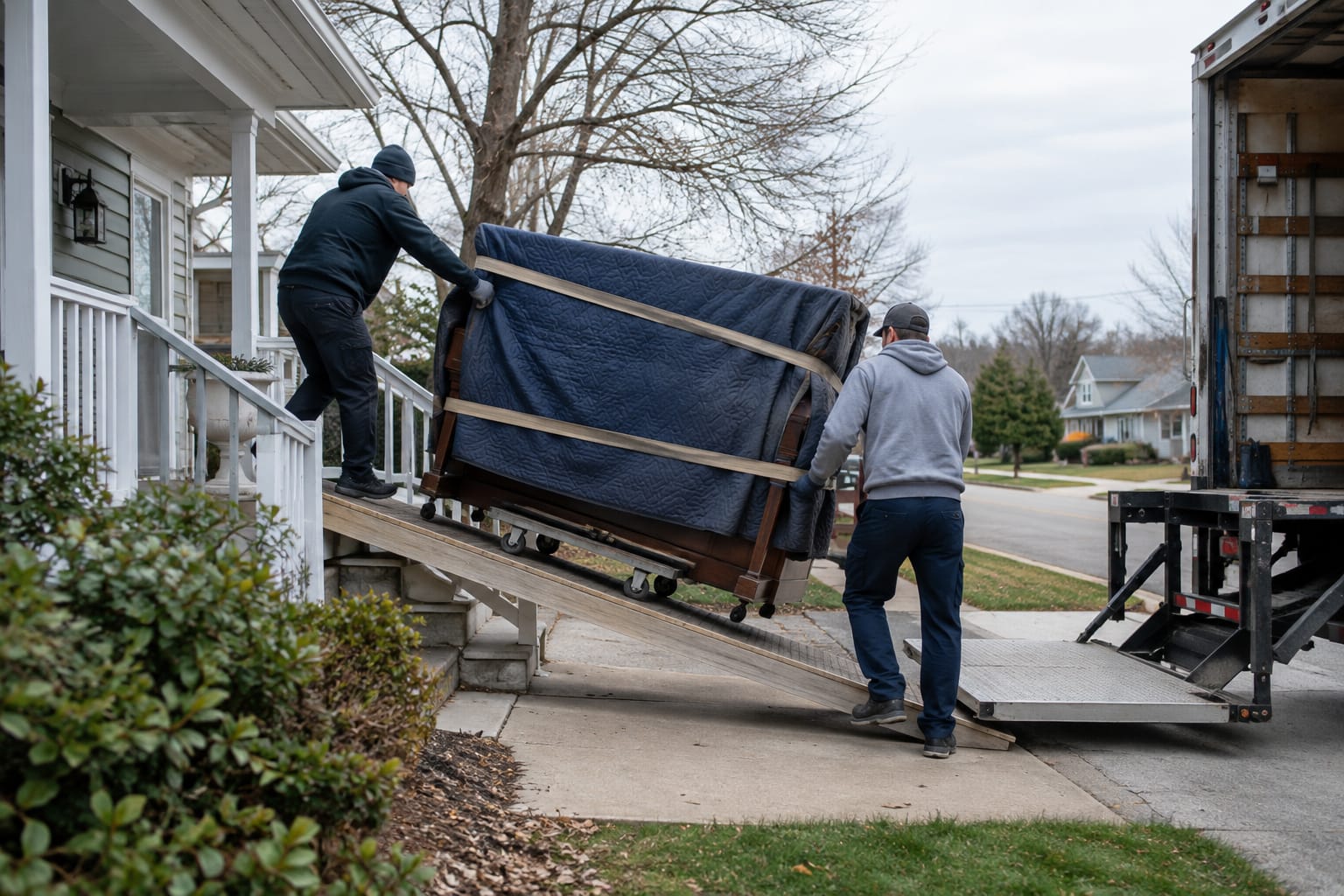
Most households moving a piano should hire a mover with specific piano experience, proper equipment, and verified licensing. A general crew that "can do pianos" is not the same thing. Moving pianos is specialized work. The instrument is heavy, top-heavy, and full of delicate parts, and a single bad turn on a staircase can damage the piano, your home, or a person.
This guide covers the move from the buyer's side. It explains how upright and grand piano moves differ and what drives the price. It also shows how to check a mover's license and valuation coverage, which questions separate real specialists from generalists, and what to do once the piano arrives.
Key Takeaways
- Hire a specialist. Most households should hire a mover with specific piano experience and equipment, including a piano board, dolly, pads, and straps.
- Grands and uprights move differently. Uprights usually travel standing on a dolly. Grands are partly disassembled and strapped on their side to a piano board.
- Verify licensing. For interstate moves, check the mover's USDOT number in FMCSA's SAFER and L&I systems. For local moves, check your state's licensing agency.
- Choose valuation carefully. FMCSA's Released Value option pays only 60 cents per pound per article. Full Value Protection, with the piano declared on the paperwork, offers stronger coverage.
- Wait before tuning. Let the piano acclimate to its new room for a few weeks before a technician tunes it.
Why Pianos Need Specialist Movers
A piano is not just a heavy box. Even a small upright weighs several hundred pounds. Most of that weight sits in a cast-iron plate under high string tension, so the piano is top-heavy and tips easily.
The weight is also unevenly distributed. Legs, pedal assemblies, and keyboard lids are fragile compared with the body they support. General movers handle mass well. Piano movers also understand balance, leverage, and pinch points, which is what keeps a piano upright on a stair landing.
Piano work also needs equipment most general crews do not carry. Common gear includes:
- Piano dollies
- A piano board, also called a skid board, which is a padded, flat board that a grand piano is strapped to on its side
- Heavy quilted pads
- Ratchet straps
- Ramps or stair-climbing equipment
For a broader look at fragile and high-value belongings, see this guide to moving pianos, art, and other specialty items.
Q: Can regular movers move a piano?
A: Many full-service movers will move a piano. Ask whether the crew assigned to your job has moved your specific type of piano and brings a piano board and dolly, because a general mover's piano work varies widely in quality.
Upright vs. Grand Pianos: How the Move Differs
The type of piano changes the crew size, the equipment, and how much disassembly is needed. Uprights usually travel standing. Grands travel on their side, partly taken apart.
| Factor | Upright piano | Grand piano |
|---|---|---|
| Position during transport | Upright, on a dolly | On its straight side, strapped to a piano board |
| Disassembly | Usually none; keyboard lid (fallboard) closed and secured | Legs, pedal lyre, and often the lid removed |
| Typical equipment | Piano dolly, pads, straps, stair-climbing gear | Piano board, padded dolly, pads, straps, tools for legs and lyre |
| Main risk points | Tipping on stairs and thresholds | Leg joints, lyre, lid hinges, and the rim during the turn onto its side |
| Reassembly at destination | Minimal | Legs, lyre, and lid reinstalled and checked for level |
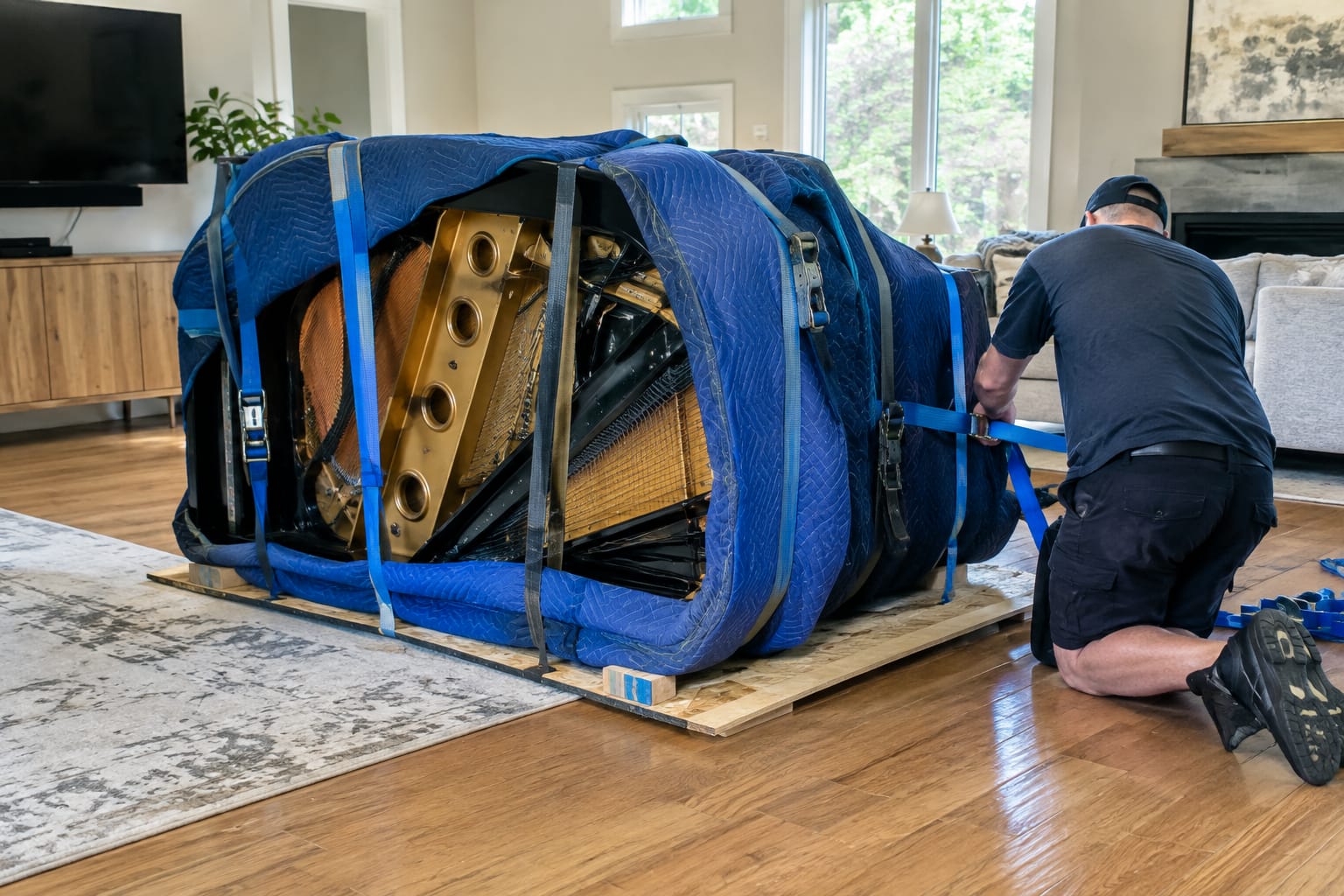
Here's the thing: grand piano moving depends heavily on technique. Turning a grand onto its side and onto the board is the moment of highest risk. A crew that has done it many times works in a set sequence. Experience matters more here than almost anywhere else in the move.
Upright piano moving looks simpler, but stairs change that quickly. A tall upright going down a narrow staircase needs controlled lowering, not muscle alone.
What Affects the Cost of Moving a Piano
Piano moving cost depends on access and distance more than on the piano alone. Quotes vary widely between companies and regions, so compare written estimates rather than relying on averages. These factors move the price most:
- Piano type and size. A grand needs disassembly, a piano board, and often a larger crew, so it usually costs more than an upright.
- Stairs and landings. Each flight, tight turn, or landing adds time and risk. Movers often price stairs separately.
- Access at both ends. Long walks from the truck, narrow doorways, elevators, and parking restrictions all add labor.
- Distance. A local move is often priced as a flat fee or by the hour. Long distance piano moving adds fuel, transit time, and handling at terminals or transfers.
- Climate control. Pianos react to temperature and humidity swings. Climate-controlled transport or storage costs more and is worth asking about for long moves.
- Timing. Weekend, holiday, and peak-season dates often carry higher rates.
- Valuation level. Choosing higher protection changes the price. This is covered in the next section.
Pro Tip: Describe access in detail when requesting quotes: the number of steps, any turns or landings, doorway widths, and the distance from the curb. Vague descriptions produce low quotes that grow on moving day.
How to Verify a Piano Mover's License and Insurance
Check a piano mover the same way you would check any mover, with extra attention to coverage. The rules depend on whether the move crosses state lines.
Interstate moves: check FMCSA records
Movers that carry household goods across state lines must be registered with the Federal Motor Carrier Safety Administration (FMCSA). FMCSA's Protect Your Move program explains how to check a mover's registration before you hire. The process is straightforward:
- Ask the mover for its USDOT number. Interstate household goods movers should also have an MC (operating authority) number.
- Search that number in the FMCSA SAFER Company Snapshot. Confirm the operating status is active and the company is authorized to carry household goods.
- Look up the same number in FMCSA's Licensing and Insurance (L&I) system. Confirm the authority type (carrier or broker) and that insurance filings are listed as active.
- Make sure the company name on the estimate matches the name on the federal record.
If the company is listed as a broker, it arranges the move but does not perform it. Ask which carrier will actually handle your piano, and check that carrier too.
Local moves: check your state
Moves within one state are often regulated by the state, not FMCSA. Depending on the state, the licensing agency is usually a public utilities commission or a department of transportation. Some states license intrastate movers and some do not, so search your state agency's records directly.
To shortlist candidates, you can filter licensed movers by specialty, location, authority type, or score, then confirm each one's federal or state record yourself.
Valuation: what happens if the piano is damaged
Valuation is the mover's level of liability for your goods. It is not insurance in the strict sense. FMCSA describes two options for interstate moves:
- Released Value comes at no extra charge but limits the mover's liability to 60 cents per pound per article. For a piano, that is a small fraction of its real value.
- Full Value Protection makes the mover liable for the replacement value of lost or damaged goods, up to the declared value of the shipment. The same FMCSA guidance notes that a mover can limit its liability for items of extraordinary value unless you list them on the shipping documents.
That last point matters for pianos. Declare the piano and its value in writing before the move. For more detail, review valuation coverage and your rights. Separate piano moving insurance through your homeowners or a specialty instrument policy is also worth checking with your insurer.
Q: Does standard mover valuation cover a piano?
A: Under FMCSA's Released Value option, the mover owes only 60 cents per pound per article, which rarely covers a piano's real value. Full Value Protection, with the piano declared on the paperwork, offers far stronger protection.
Questions to Ask Before You Book
These questions separate true piano movers from general crews. A qualified mover answers them directly and puts the key terms in writing.
- How many pianos of my type (upright, baby grand, concert grand) has this crew moved?
- Will your own employees do the move, or will it go to a subcontractor or another carrier?
- What is your USDOT number, and are you licensed for this move under federal or state rules?
- Will you bring a piano board, padded dolly, straps, and stair equipment?
- How many movers will be on the crew?
- For a grand: who removes and reinstalls the legs, lyre, and lid?
- How do you price stairs, landings, and long carries?
- Is the estimate binding or non-binding, and what could change the final price?
- What valuation options do you offer, and how do I declare the piano's value?
- For long distance: is the piano transported in a climate-controlled truck, and will it be transferred between vehicles?
- What is your claims process if something is damaged?
The same habits apply when vetting any moving company: get estimates in writing, avoid large cash deposits, and read the paperwork before signing.
Preparing Your Home and the Piano for Moving Day
Good preparation shortens the job and lowers the risk. Leave the lifting to the crew and focus on the path and the paperwork.
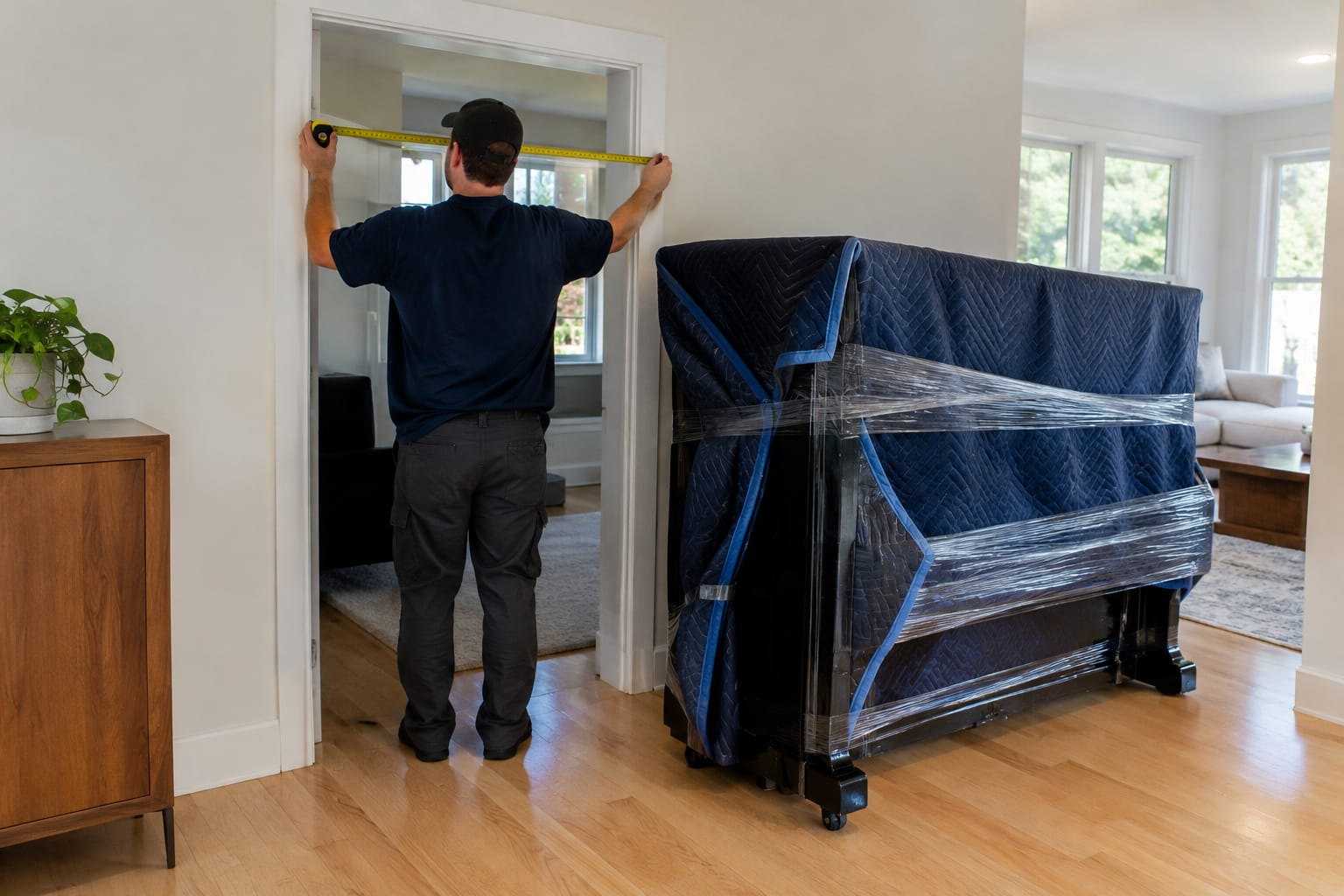
- Measure the route. Measure doorways, hallways, stair widths, and any tight turns at both homes. Share those numbers with the mover before moving day.
- Clear the path. Remove rugs, furniture, and décor from the route. Protect floors if the mover does not bring floor covering.
- Empty the piano. Remove photos, sheet music, and anything stored on or inside the bench or the piano.
- Close and secure the fallboard. The crew will secure it, but closing it yourself prevents accidental key damage.
- Arrange access. Reserve elevators and loading docks. Plan parking for the truck as close to the door as rules allow.
- Plan the destination spot. Choose a place away from heating vents, radiators, and direct sun, since these cause temperature and humidity swings.
- Document the condition. Photograph the piano from all sides, including any existing scratches, before the crew arrives.
Q: How to move a piano up or down stairs safely?
A: Use a crew of at least three people with a piano dolly or stair-climbing equipment, with one person controlling the lower end at all times. Stairs are where most DIY attempts go wrong, and the main reason specialist piano movers price them separately.
After the Move: Acclimating, Tuning, and Inspecting for Damage
The move is not finished when the piano is through the door. Inspect it before the crew leaves, then give it time to settle before tuning.
Inspect before you sign
Check the cabinet, legs, lid, and pedals for scratches or looseness. Play every key and press each pedal. Note any damage on the delivery receipt or inventory before you sign. That written note supports any later claim.
For interstate moves, federal law requires carriers to allow at least nine months to file a damage claim. File in writing as soon as you find a problem.

Let it acclimate, then tune
Piano tuning after a move should wait until the instrument adjusts to its new room. Changes in temperature and humidity affect the wooden soundboard and the string tension. Piano technicians commonly advise waiting a few weeks before tuning, so the tuning holds instead of drifting.
The Piano Technicians Guild is the professional organization for piano technicians and certifies Registered Piano Technicians (RPTs). A technician can also confirm that a reassembled grand is level and that the action and pedals work correctly after the move.
FAQ
Should I move a piano myself?
For most households, no. Even a short move within the same home involves a heavy, top-heavy object, and the injury and property-damage risks are high. DIY moves also have no mover valuation coverage if something breaks.
Can I ship a piano in a portable moving container?
It is possible, but the container company usually does not load or secure the piano. A piano mover still needs to load, strap, and unload it. Check the container's terms, and ask whether the unit is exposed to temperature extremes in transit or storage.
What should happen if the mover arrives without a piano board or dolly?
Pause the job and ask how they plan to move the piano without them. Equipment was part of the questions to ask before booking. A crew that arrives without basic piano gear is a reason to reschedule rather than proceed.
Written by USA Moving Advisor Team
Useful Links
- Moving Pianos, Art, and Other Specialty Items
- Browse Verified Moving Companies
- How to Vet a Moving Company in 7 Steps
- Your Rights When You Move: BOL, Inventory, and Valuation
Need help with this? DEMOULAS SUPERMARKETS INC · Contact us